From Luxury Good to Extortionate Product: Why Chocolate Becomes Unaffordable
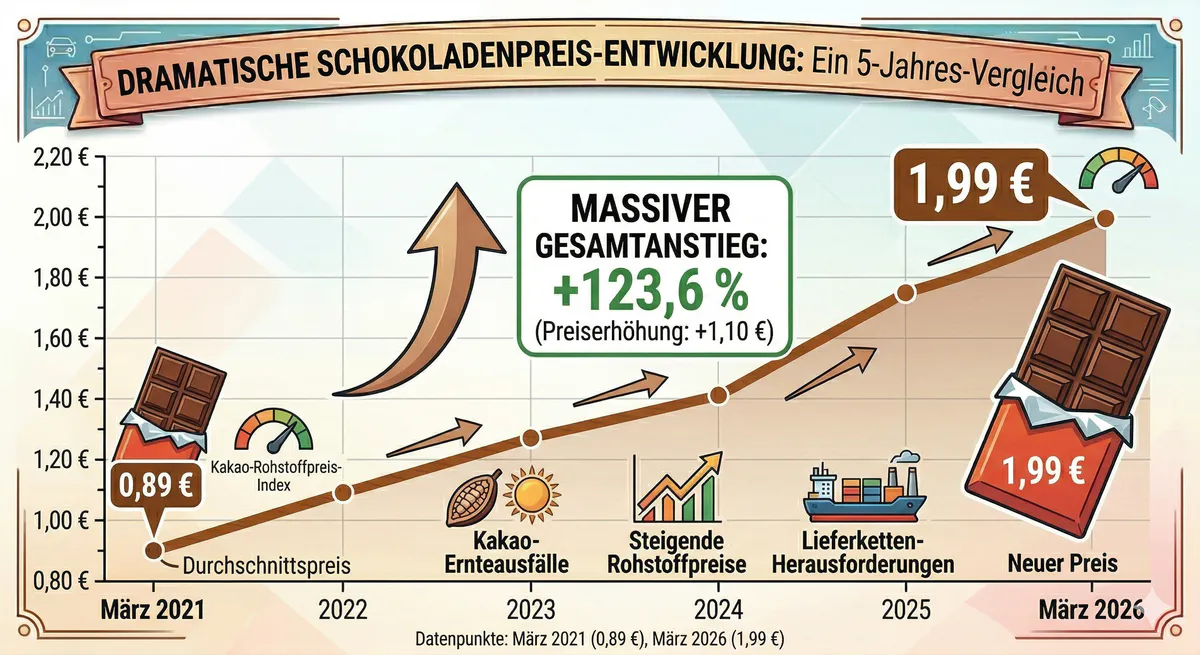
An analysis of exploding chocolate prices between 2021 and 2026, the nasty trick of shrinkflation, and the question of greedflation.
The Bitter Aftertaste: When Chocolate Becomes a Luxury
Do you remember 2021? The world was complicated, but at least at the supermarket checkout, there were still small moments of joy. If you fancied something sweet, you'd reach for your favorite bar of chocolate. Price for the standard brand on offer: often under one Euro.
Today, in March 2026, the world looks different. A walk through the confectionery aisle feels like a shock. Chocolate is no longer a small everyday pleasure; it is increasingly becoming a luxury good.
Behind this development lies much more than just general inflation. It's a combination of exploding raw material prices, a particularly brazen form of hidden price increase (shrinkflation), and the urgent question: are corporations simply lining their pockets here?
The Stark Figures of Horror (2021 vs. 2026)
Let's look at the price development of a fictitious standard bar (which we traditionally knew as a 100g bar):
- March 2021: A typical price for a branded bar (like Milka) was approximately 0.89 Euros.
- March 2026: Five years later, the same variety regularly costs 1.99 Euros.
That's a pure price increase of a hefty 123.6%.
But that's only half the truth. Because parallel to the price increase, many manufacturers have resorted to a psychological trick.
The Double Whammy: Less Content for More Money (Shrinkflation)
The price increase itself is already steep. But it gets truly brazen when you factor in shrinkflation – the secret reduction of package size at the same (or in this case, even increasing) price.
Let's take the prominent example of Milka (Mondelez). The trend started years ago, but by today (2026), it has become common for almost all varieties: the standard bar no longer weighs 100g, but only 90g.
The Example Calculation: What Does a Kilo Really Cost?
To understand the true price increase, we need to compare the price per kilo. This exposes the corporations' trick.
Calculation 1: March 2021 (The Good Old Days)
- Price: €0.89 for 100g
- Price per kilo = €0.89 * 10 = €8.90 / kg
Calculation 2: March 2026 (The Bitter Reality)
- Price: €1.99 for 90g
- Price per gram = €1.99 / 90g ≈ €0.0221
- Price per kilo = €0.0221 * 1000 = €22.11 / kg
The Conclusion: The price per kilo for chocolate has risen from €8.90 to €22.11. That's a real price increase of almost 148%!
Consumers are therefore paying more than two and a half times as much for the same amount of chocolate, while being psychologically deceived by the 90g bar into thinking the price jump isn't quite so drastic.
Cost Trap or Greedflation: Who Benefits?
The chocolate industry tirelessly emphasizes why these prices are necessary.
- Cocoa Prices: Indeed, extreme weather events (El Niño) in West Africa (Ivory Coast, Ghana) have led to massive crop failures for years. Cocoa prices on commodity exchanges already reached historical highs in 2024 and have remained extremely high to this day (2026).
- Sugar and Milk: Prices for other ingredients, as well as energy and logistics, have also risen.
But does that justify a price increase of 148%? Consumer advocates and economists are skeptical.
The suspicion of greedflation is circulating: companies are using the general inflationary mood and the real cocoa problems as a pretext to disproportionately raise prices and thus embellish their profit margins.
Sources of Doubt: Why the Industry's Arguments Fall Short
Even during the first major price jump around 2024, there were strong voices questioning the industry's narrative:
- Hamburg Consumer Protection Center: The VZ Hamburg is the authority when it comes to uncovering "deceptive packaging" and shrinkflation. For years, they have criticized that price increases often significantly exceed increased raw material costs, and that corporate profit margins remain high or even increase despite crisis rhetoric. (Cf. the regular list of Deceptive Packaging from the Hamburg Consumer Protection Center).
- Economic Analyses (2024/2025): Reports from Finanzcheck or Agrarheute already showed early on that while the market price for cocoa exploded, large corporations (Nestlé, Mondelez, Lindt) often have long-term supply contracts and only feel the cost increases with a significant delay. Nevertheless, supermarket prices were often raised immediately.
- Studies on Greedflation (General): Economists (e.g., from the IFO Institute in Germany or the ECB in earlier analyses) have found that in some sectors, corporate profits have contributed more to inflation than increased wage or import costs. It is plausible that the highly concentrated chocolate industry (a few large players) is utilizing this market power.
Conclusion: Is it Time to Forego Consumption?
Yes, cocoa has become scarce and more expensive. But the way corporations like Mondelez (Milka) double prices and simultaneously shrink portions leaves a very bitter taste. It's hard to believe that merely "costs are being passed on" here. It strongly smells of profit maximization at the expense of consumers, who are attached to their little comfort.
What can we do?
- Compare prices: Always look at the unit price (Euros per kilogram) on the shelf, not the final price of the bar.
- Switch to alternatives: Often, discounter own brands (which have also kept their 100g weight) are still more tolerable in price.
- Boycott/Consumption Strike: If a bar costs 2 Euros, the time may have come to treat chocolate again as what it historically was: a rare, expensive indulgence and not an everyday item. Perhaps corporations only understand this language.