The Throne in Heaven, Chaos on Earth: Why Religion Often Clashes with Democracy
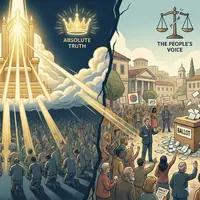
The longing for the Absolute Democracy is demanding. It is based on compromise, grey areas, and the painful realization that no one possesses the complete truth. Religion, on the other hand, often offers precisely the opposite: an absolute truth, a clear morality, and a divine legislator who is not subject to elections. In this field of tension, a desire for anti-democratism often arises – not out of malice, but from a deep yearning for order, purity, and a supposedly higher justice. We look behind the scenes of these motivations.
Deep Dive: The Psychology of Religious Anti-Democratism
- The Hierarchy of Obedience vs. the Level of Equality
In many religious worldviews, reality is hierarchically ordered: God is at the top, followed by His representatives or scriptures, and at the very bottom is man. This vertical structure stands in stark contrast to the horizontal structure of democracy, where every vote has equal value – completely regardless of moral or spiritual "maturity".
For a deeply religious person, it can feel like a betrayal of truth when the voice of an "ungodly" person or a "sinner" carries the same weight as that of a believer. The desire for anti-democratism here is often the wish to restore the divine order, where truth reigns and not the majority.
- The Need for Epistemic Certainty
The modern world is complex, pluralistic, and often confusing. Democracy reflects this complexity by constantly negotiating values. Many people, however, seek an anchor in religion – an unchangeable truth.
Anti-democratic tendencies here stem from the fear of "relativism." When everything is up for debate (abortion, marriage, ethics), believers often perceive this as moral decay. A strong, religiously legitimized leader or a theocratic system promises to protect "eternal values" from the whims of the fickle electorate.
- God as the Only Legitimate Lawgiver
A central motive for religiously motivated anti-democratism is the rejection of popular sovereignty. In a democracy, all power emanates from the people. In radical religious movements, all power emanates from God (God's sovereignty).
When parliament passes laws that contradict sacred texts, democracy becomes an usurpation in the eyes of believers. They then see the state not as a neutral mediator, but as an "idol" that elevates itself above the Creator. In this case, the fight against democracy is stylized as a sacred duty.
- Identity and the "Us vs. Them" Narrative
Religion offers a strong group identity. Democracy, however, requires us to define ourselves as citizens of a state who must coexist with people of completely different beliefs.
The desire for an anti-democratic upheaval often stems from the urge for community purity. One no longer wants to have to negotiate with "the others." An authoritarian system that favors one's own religion ends the painful process of plurality and elevates one's own group to the sole norm.
- The Apocalyptic Longing
An often underestimated factor is eschatology – the doctrine of the last things. Many anti-democratic religious movements believe that the world is in a final struggle between good and evil. In this "war," arduous parliamentary debate is merely an obstacle. People long for a messianic moment that sweeps away the corrupt human order and establishes the Kingdom of God (or a corresponding utopian order).
Conclusion: When Faith Fears Freedom
Religiously motivated anti-democratism is rarely a rejection of justice per se, but rather a rejection of human fallibility within political systems. The desire for a rule that no longer needs to be negotiated is an escape from the responsibility of compromise.
The challenge for modern societies remains to integrate religious beliefs in such a way that they recognize democracy as the space that first enables them the freedom to practice their faith – even if this space can never be "absolute".
The bottom line: Whoever seeks God on the ballot will always be disappointed in a democracy – and precisely this disappointment is the breeding ground for the desire for a system change.